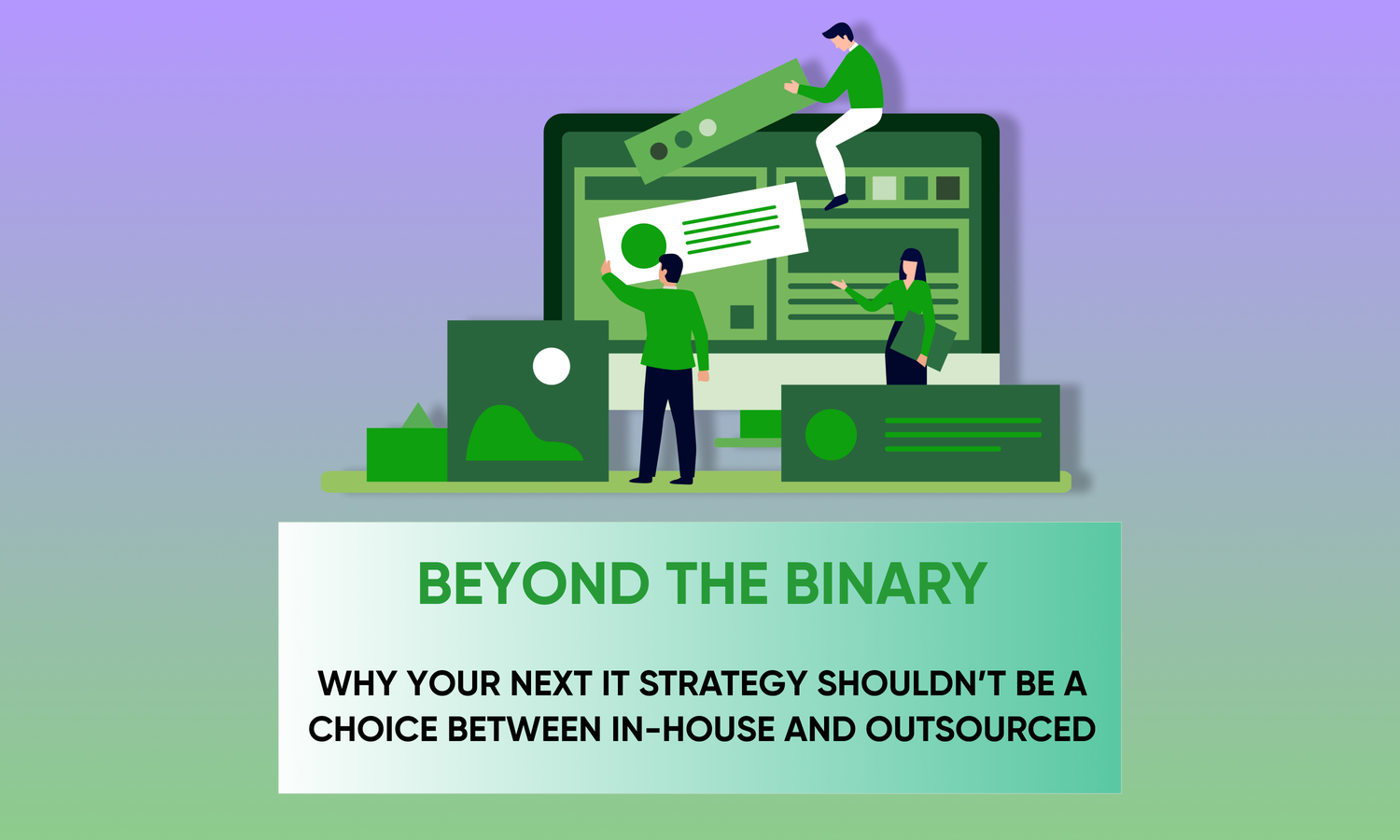
Beyond the Binary: Why Your Next IT Strategy Shouldn’t Be a Choice Between In-House and Outsourced
By JoeVu, at: Feb. 13, 2026, 10:24 a.m.
Estimated Reading Time: __READING_TIME__ minutes
Early 2010s, the playbook for scaling a business was relatively simple: you either built an internal empire of developers and sysadmins, or you "tossed the keys" to a global Managed Service Provider (MSP) to save on OpEx. It was a binary world. You chose control at the cost of scalability, or scalability at the cost of your "institutional soul."
As someone who has spent over a decade at the intersection of entrepreneurship and technical architecture, I can tell you: that binary is dead.
If you are still treating outsourcing as an "all-or-nothing" proposition in 2025, you aren't just behind the curve, you are building a fragile organization. The most resilient companies today are moving toward a Hybrid (Co-Managed) IT Model. This isn't just a trend; it is the only way to scale without losing your "Tribal Knowledge."
The "Two-Lane" Architecture
The failure of traditional outsourcing often stems from a lack of role clarity. In a professional, high-growth environment, your IT operations should be split into two distinct lanes:
-
Lane 1 (The Strategic Core): This stays in-house. These are your "Context Experts." They understand the why - why your specific database schema is built that way, why certain legacy integrations exist, and how technology serves your unique business roadmap.
-
Lane 2 (The Operational Engine): This is your Partner. They handle the how, the 3:00 AM server alerts, the 24/7 help desk, the "commodity" patching, and the specialized niche skills (like Kubernetes or AI Ethics) that you only need 10% of the time.
By splitting the lanes, you stop your internal geniuses from wasting 40 hours a week on "firefighting" and start using them as Architects of Growth.
The "Tribal Knowledge" Trap
The biggest criticism of the old "Full Outsourcing" model is the "Brain Drain". When a vendor handles everything, your company’s intelligence begins to leak out of the building. After three years, no one internally knows how the system actually works. This is a catastrophic risk in a world where software is your primary competitive advantage.
The Professional Insight: In a Hybrid model, the internal team manages the Knowledge Base (like AWS BedRock). You use AI-driven documentation tools to ensure that while the vendor executes the task, the logic remains company property. You aren't just buying "hours"; you are buying "capacity" while retaining the "intellect."
Operational Elasticity as a Financial Weapon
From an entrepreneurial standpoint, hiring is a "heavy" activity. Every full-time hire adds management overhead, benefits, and most importantly rigidity. In a volatile market, rigidity is the enemy of survival.
The Hybrid model introduces Elasticity. When you launch a new product or face a sudden security audit, you don't need to embark on a 6-month hiring spree. You ramp up your partner’s "on-demand" specialists immediately. When the project ends, you ramp down. You turn IT from a fixed "Real Estate" cost into a "Utility" cost. This allows you to deploy capital into growth-driving R&D rather than maintenance headcount.
Key Takeaways for the 2025 Leader
-
Stop Firefighting: If your senior developers are resetting passwords or manually patching servers, you are losing money. Outsource the "noise" to protect the "signal."
-
Audit Your "Context": Identify the 20% of your tech stack that actually makes you unique. Never, under any circumstances, let that knowledge leave your internal team.
-
Demand Transparency: A professional partner in 2025 shouldn't be a black box. They should integrate into your Slack, your Jira, and your culture. If they don't use your tools, they aren't your partner - they're just a vendor.
Frequently Asked Questions (FAQs)
How do I decide what to keep in-house versus what to outsource?
Use the "Context vs. Core" framework. If a task provides a direct competitive advantage or requires deep knowledge of your specific business logic (Context), keep it in-house. If it is a standard industry requirement like network uptime or Tier 1 support (Core/Commodity), it is a candidate for a hybrid partner.
Doesn't a hybrid model create more management overhead for my team?
Initially, yes - you are moving from "doing" to "governing." However, a professional partner should use your existing ITSM tools (like Jira or ServiceNow). When the workflows are integrated, the "management" becomes a natural part of your sprint cycles rather than an extra layer of meetings.
Is my data safe if I give an external partner 24/7 access?
Safety depends on "Least Privilege" access. In a hybrid model, you grant vendors specific roles with MFA and continuous audit logging. Unlike traditional models where the vendor "owns" the environment, in a hybrid setup, you own the environment and the logs, giving you full visibility into every action the partner takes.
How does AI change the cost of these partnerships?
AI is significantly reducing the labor hours required for routine maintenance. When negotiating with a hybrid partner, ensure your contract includes "Productivity Commitments." As their AI tools make them more efficient, those savings should be shared with you, either through lower costs or by reallocating that time to higher-value innovation projects.
The Bottom Line
The goal of modern outsourcing isn't to save 20% on your payroll - it's to increase your Innovation Velocity. It’s about making sure that when opportunity knocks, your internal team has the mental bandwidth to answer the door, while your partner keeps the lights on and the windows locked.
![[Useful Site Review] Gumloop.com](/media/filer_public_thumbnails/filer_public/4e/c3/4ec3a522-0124-471d-ab58-d6a1910d1cf1/useful_site_review_gumloopcom.png__400x240_crop_subsampling-2_upscale.png)
![[TIPS] Python Mixins - LoggingMixin](/media/filer_public_thumbnails/filer_public/2a/7a/2a7a2503-b421-4058-8a7d-d945f7b112c6/python_mixins_-_loggingmixin.png__400x240_crop_subsampling-2_upscale.png)