Bridging the Chasm: The Future of Design-Engineering Collaboration in the Age of AI Reasoning
By JoeVu, at: Jan. 26, 2026, 2:52 p.m.
Estimated Reading Time: __READING_TIME__ minutes
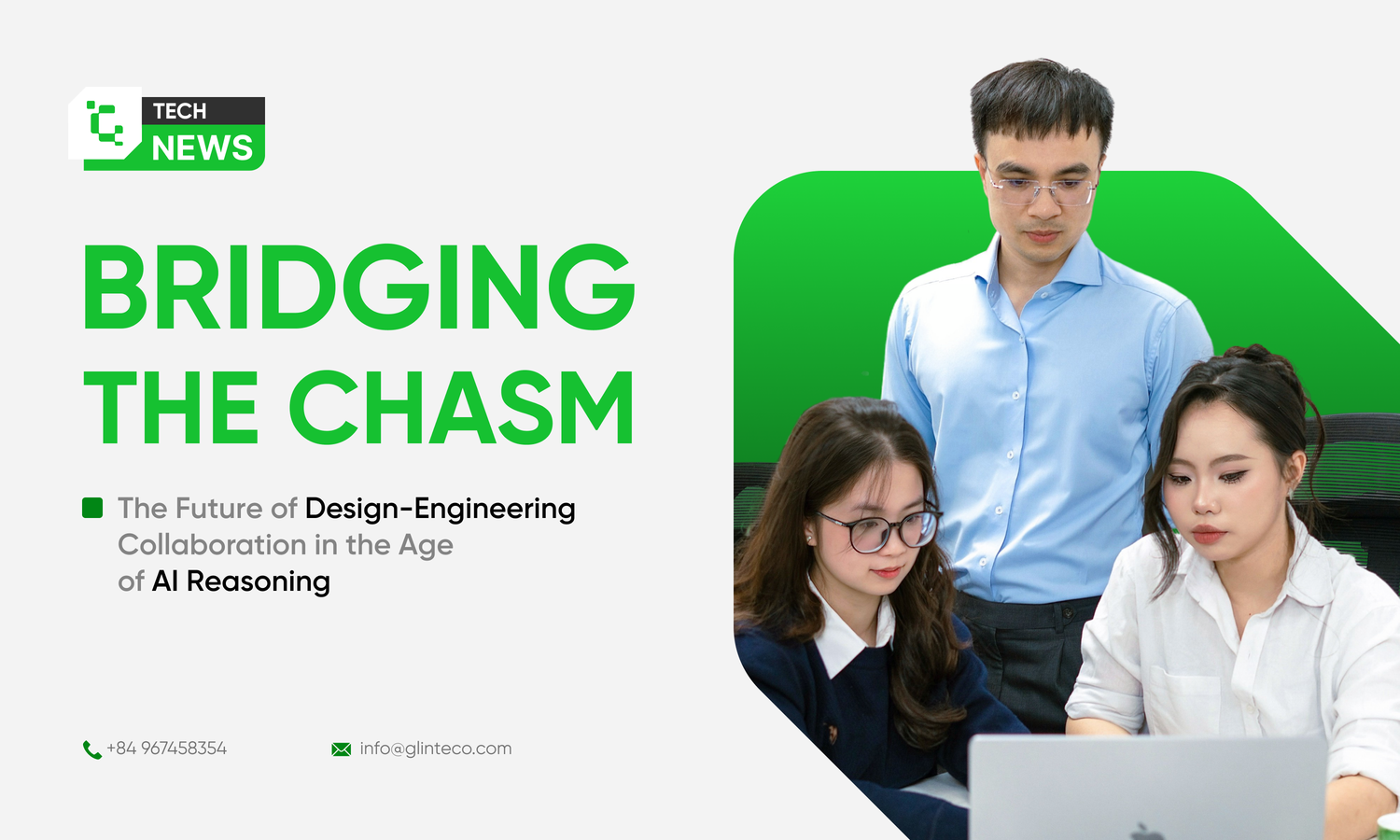
The software development landscape of early 2026 is no longer defined by the manual translation of pixels to syntax. As we move further into a year where "vibe coding" has transitioned from a niche developer trend to a professional methodology, the "wall" between design and frontend engineering is finally beginning to crumble.
At Glinteco, we’ve seen that the most successful projects aren’t just about choosing the right tech stack (whether it’s the newly released Django 6.0 or a custom Generative AI implementation) but about how teams bridge the gap between design intent and production reality.
The $58,500 Monthly Drain: The Cost of "Broken Handoffs"
In various firms/organizations, the transition from Figma to code remains a high-friction "handoff" rather than a continuous partnership. Research indicates that for a 10-person product team, inefficiencies in this process, such as "spec guessing" and endless back-and-forth loops, can cost upwards of $58,500 per month.
We’ve all been there. You throw a Figma file "over the wall" and hope for the best. But the teams that are actually winning in 2026 are doing things differently:
-
The 95/5 Rule: (not 80/20 anymore) Focus 95% of collaborative effort on the primary user flow, but meticulously design the 5% of "edge cases" (error states, loading transitions, and empty screens) that define the actual user experience.
-
Integrated "Pods": Following the Intercom model, teams sit in cross-functional pods where designers and engineers share accountability—designers for the researched problem, and engineers for the high-quality, timely delivery of the solution.
Technical Spotlight: UI-UX Pro Max and "Design Intelligence"
Lately, we’ve been digging into the UI-UX Pro Max skill. Honestly, it’s refreshing. Most "Figma-to-Code" tools just spit out messy code that nobody wants to touch. But this one works as a "reasoning layer" for AI.
Why This Matters for 2026
Our technical evaluation of the UI-UX Pro Max v2.0 repository reveals a sophisticated approach to maintaining design integrity at scale :
-
BM25 Ranking for Relevance: The skill uses the BM25 (Best Match 25) algorithm to search its internal databases of 57 styles and 95 palettes, ensuring that the AI recommends industry-appropriate aesthetics rather than generic patterns.
-
Master + Overrides Pattern: It introduces a hierarchy where a global
MASTER.mdsets the design system tokens, while page-specific files (likecheckout.md) can provide contextual overrides. This mimics the way enterprise-scale systems, like Airbnb's DLS, handle complexity across diverse platforms.
-
Context-Aware Anti-Patterns: One of the most critical "expertise" signals for AI in 2026 is knowing what not to do. The skill explicitly blocks "AI purple/pink gradients" for high-security contexts like banking, recognizing that brand trust is built on industry-specific visual languages.
Observability: Treating Design Like Code
The next frontier for Glinteco and the broader industry is Design System Observability. Following Uber’s lead, forward-thinking teams are now treating design quality as an engineering metric, comparable to test coverage or latency.
Uber’s "Base Counter" triggers during screen-level navigation to quantify how many components are official "Base" UI elements versus custom code. This data-driven approach allows leadership to see exactly where design debt is accumulating, ensuring consistency as the codebase scales.
Moving Beyond the Handoff
As we integrate more AI into our workflows, the human element becomes even more critical. Google’s latest search algorithms now prioritize content that demonstrates real-world testing and specific new information. In the same vein, the best digital products in 2026 will be those where:
-
Developers are involved during the design phase for feasibility checks.
-
Designers propose changes via PRs with live previews, allowing them to iterate against the real codebase rather than a static mock.
-
Common Language is Standardized: Using design tokens as "semantic glue" ensures that when a designer says
primary-button, the developer is already looking at the same coded component.
At Glinteco, we don't just build websites; we build scalable digital infrastructure. By leveraging the latest in AI design intelligence and fostering a culture of "no-surprise handoffs," we help our partners cut engineering time by nearly 50% while improving product consistency.