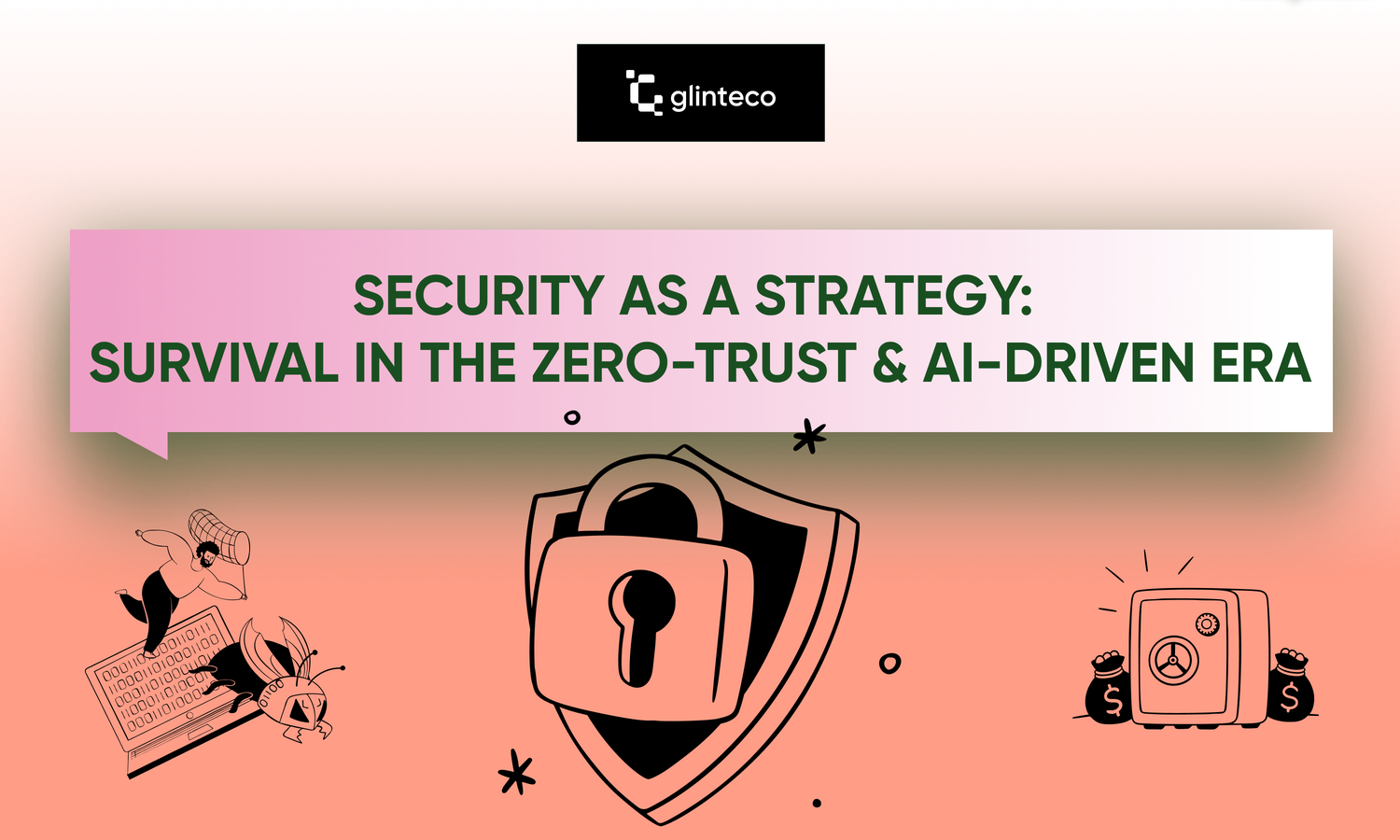
Security as a Strategy: Survival in the Zero-Trust & AI-Driven Era
By dunghv, at: Dec. 20, 2025, 2:53 p.m.
Estimated Reading Time: __READING_TIME__ minutes
IT early days, security was a "moat": once you were inside the network, you were trusted.
In 2025, that moat has evaporated. Your employees are accessing sensitive data via mobile apps from cafes in Sydney, co-working spaces in Ho Chi Minh City, and home offices globally.
As a CXO, viewing security as a "checklist" is a liability. If your digital infrastructure isn't Secure-by-Design, you aren't just building an app; you are building a ticking financial time bomb.
The Critical Reality: Why ZTA is the Board’s New Priority
The "Castle-and-Moat" model is dead because the perimeter no longer exists.
-
The Lateral Threat: Traditional VPNs grant broad "access to the building." If a single credential is stolen, a hacker can move laterally from a low-risk HR portal to your core financial databases
-
Zero-Trust Architecture (ZTA): The core principle is "Never Trust, Always Verify". Every request from the CEO’s mobile dashboard to a developer’s code commit in Vietnam must be authenticated, authorized, and encrypted based on real-time context (device health, location, and behavior)
-
The "Blast Radius" Mitigation: Using Micro-segmentation, we isolate data into digital "vaults." If your web app is breached, the attacker is trapped in a locked room, unable to see or touch the rest of your architecture.
Security as a Sales Accelerator (The "Enterprise-Ready" Moat)
Security is often blamed for "friction," but in 2025, it is a revenue driver.
-
Winning the "Whales": Large corporate clients will no longer sign $1M+ contracts without a SOC2 Type II report or ISO27001 certification
-
Shortening Sales Cycles: Enterprise deals stuck in security reviews for 6–8 months can close in 4–6 weeks when you demonstrate a mature Zero-Trust architecture. This "pulls forward" millions in ARR
-
AI-Enhanced Defense: Using AI to detect "Impossible Travel" (e.g., a login in Melbourne followed by one in HCMC 10 minutes later) provides proactive protection that traditional firewalls can't match
| Feature | Australia (2025) | Vietnam (2025) |
|---|---|---|
| Legal Liability | New Statutory Tort: Individuals can now sue for "serious invasion of privacy" without proving financial loss. The $3M small business exemption is effectively dead for 90% of firms. | PDPL 2025: New law effective Jan 1, 2026. Mandates strict "Data Processing Impact Assessments" (DPIAs) and designates the Ministry of Public Security as the lead enforcer. |
| Max Penalties | The greater of $50M, 3x the benefit gained, or 30% of adjusted turnover. Average breach cost has risen to $4.44M per incident. | Fines up to 5% of total annual revenue for cross-border violations. Illegal data trading carries a minimum fine of VND 3 Billion (~$120k USD). |
| Market Driver | Fiduciary Duty: Boards are now legally liable for "unreasonable" security delays. Security is the #1 hurdle for M&A and enterprise sales. | Digital Sovereignty: Aggressive push for local data centers (Viettel, CMC) to comply with data residency rules while scaling e-commerce. |
| Talent & Costs | Crisis Mode: Severe GRC and Cyber architect shortage. Average salary for a Lead Security Engineer exceeds $220k AUD. | Growth Mode: Massive surplus of Technical SecOps talent. Highly effective for 24/7 monitoring at 1/4 the cost of Australian talent. |
The Hard Questions
Q: "We’re too small to be a target. Why spend $50k on Zero-Trust?"
A: In 2025, attackers use AI to scan millions of SMEs simultaneously. You aren't being "targeted" by a person; you’re being harvested by a bot. The 2025 Privacy Act update removed the small business exemption ($3M revenue) for 90% of businesses—you are now legally liable regardless of size.
Q: "How does this actually help my mobile app's User Experience (UX)?"
A: It enables Passwordless Auth. By using FIDO2 and Biometrics, users never have to remember a password. This reduces login friction by 40% while being 100% more secure than traditional SMS codes (which are now easily bypassed by AI-phishing kits).
Q: "I use a team in Vietnam for my web app. How do I know they are compliant with Australian law?"
A: You must verify their Data Sovereignty protocols. Under the 2025 laws, you are liable for your vendors. Ask: "Is our Australian customer data encrypted at rest using keys we control (AWS KMS / Azure Key Vault)?" and "Do you have a 24/7 SecOps monitoring our CI/CD pipeline?" If they say "no," you are effectively giving them a master key to your company’s legal downfall.

![[One Package Per Day] Pre-Commit](/media/filer_public_thumbnails/filer_public/0d/2a/0d2a47b0-1c62-42bf-91ae-ef67015bfc00/one_package_per_day_-_pre-commit.png__400x240_q85_crop_subsampling-2_upscale.jpg)