The Agility of Resilience: Why Vietnamese Devs Pivot Faster to AI and Web3
By tung.nguyenthanh, at: Nov. 23, 2025, 8:58 p.m.
Estimated Reading Time: __READING_TIME__ minutes

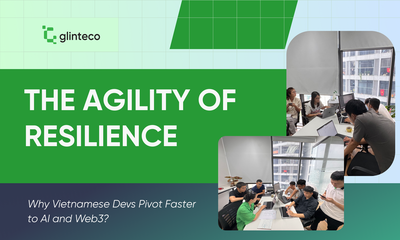
In the global tech landscape, "legacy" is often a polite word for "baggage". Mature tech hubs often struggle to adopt new paradigms because they are anchored by decades of old code and traditional processes. Vietnam, by contrast, possesses a unique cultural trait that I call the Agility of Resilience.
Born from a history of rapid rebuilding and a "start from zero" mindset, the Vietnam IT workforce doesn't just adapt to emerging technologies, it colonizes them. Whether it’s the transition from Web2 to Web3 or the current generative AI explosion, Vietnamese developers are often the first to cross the border.
The Grassroots Tech Revolution: Leading the World in Crypto and AI
This isn't just an observation; the data for 2025 is staggering. According to the 2025 Chainalysis Global Crypto Adoption Index, Vietnam ranks 4th in the world for digital asset adoption. In a country where banking infrastructure was once a hurdle, the population simply "leapfrogged" traditional finance directly into decentralized systems.
We are seeing the same phenomenon in Artificial Intelligence. The Google e-Conomy SEA 2025 report reveals that Vietnam leads Southeast Asia in AI user readiness and trust, with 81% of digital users engaging with AI tools daily. While Western markets often debate the ethics of AI for years, Vietnamese developers are already building.
Why Resilience Equals Agility
To understand this agility, you have to understand the Vietnamese developer's relationship with change. In more established economies, change is a risk to be managed. In Vietnam, change is the only path to competitive advantage.
The Professional Insight: Vietnamese engineers treat new frameworks like AI or Blockchain as "The Great Equalizers." They know they cannot out-spend Silicon Valley on legacy infrastructure, but they can out-learn them on the new frontiers. This is why you see a 78% revenue growth in AI-featured apps in Vietnam this year alone. They aren't just using AI; they are embedding it into the core of their software outsourcing delivery models.
From Execution to Innovation: The 2025 Pivot
2025 marks a turning point that FPT CEO Nguyen Van Khoa calls “The Year of Business Value” for AI. We are moving past the "Proof of Concept" phase. Vietnamese teams are now deploying:
-
Domain-Specific LLMs: Tailored models for finance, healthcare, and logistics.
-
Autonomous AI Agents: Moving beyond simple chatbots to agents that can manage entire workflows.
-
Web3 Integrations: Solving real-world supply chain and transparency issues using blockchain logic.
Frequently Asked Questions (FAQs)
Is Vietnam ready for the security challenges of AI and Web3?
Yes. In late 2024 and early 2025, the Vietnamese government introduced its first AI Law, focusing on transparency, ethics, and data sovereignty. This regulatory framework provides a "safe harbor" for Western firms who want to innovate without the risk of legal ambiguity.
Is there an AI talent shortage in Vietnam?
There is a high demand for senior AI architects, which is a global issue. However, the Vietnamese "STEM DNA" (discussed in Post 1) means the pipeline of junior-to-mid talent is filling faster than almost anywhere else. Programs like AWS’s "AI Ready" initiative have already trained over 100,000 Vietnamese individuals in cloud and AI skills.
Can a Vietnamese team help us migrate from legacy systems to AI-native ones?
This is their "sweet spot." Because they aren't emotionally attached to legacy stacks (COBOL, older Java versions), they are highly efficient at "refactoring for the future." They see a legacy migration as an opportunity to implement a modern, AI-first architecture.
How does the government support this tech agility?
The National AI Strategy to 2030 is a massive tailwind. The government is investing 3-4% of the national budget into science and technology, aiming to make Vietnam a top 4 ASEAN AI powerhouse.
The Bottom Line
If your company is still treating outsourcing to Vietnam as a way to save on maintenance, you are missing the biggest opportunity of the decade. The Vietnamese team of 2025 is an Agile R&D partner. They are the ones who will help you navigate the AI transition while your local teams are still arguing about the roadmap.
![[Useful Site Review] Gumloop.com](/media/filer_public_thumbnails/filer_public/4e/c3/4ec3a522-0124-471d-ab58-d6a1910d1cf1/useful_site_review_gumloopcom.png__400x240_crop_subsampling-2_upscale.png)