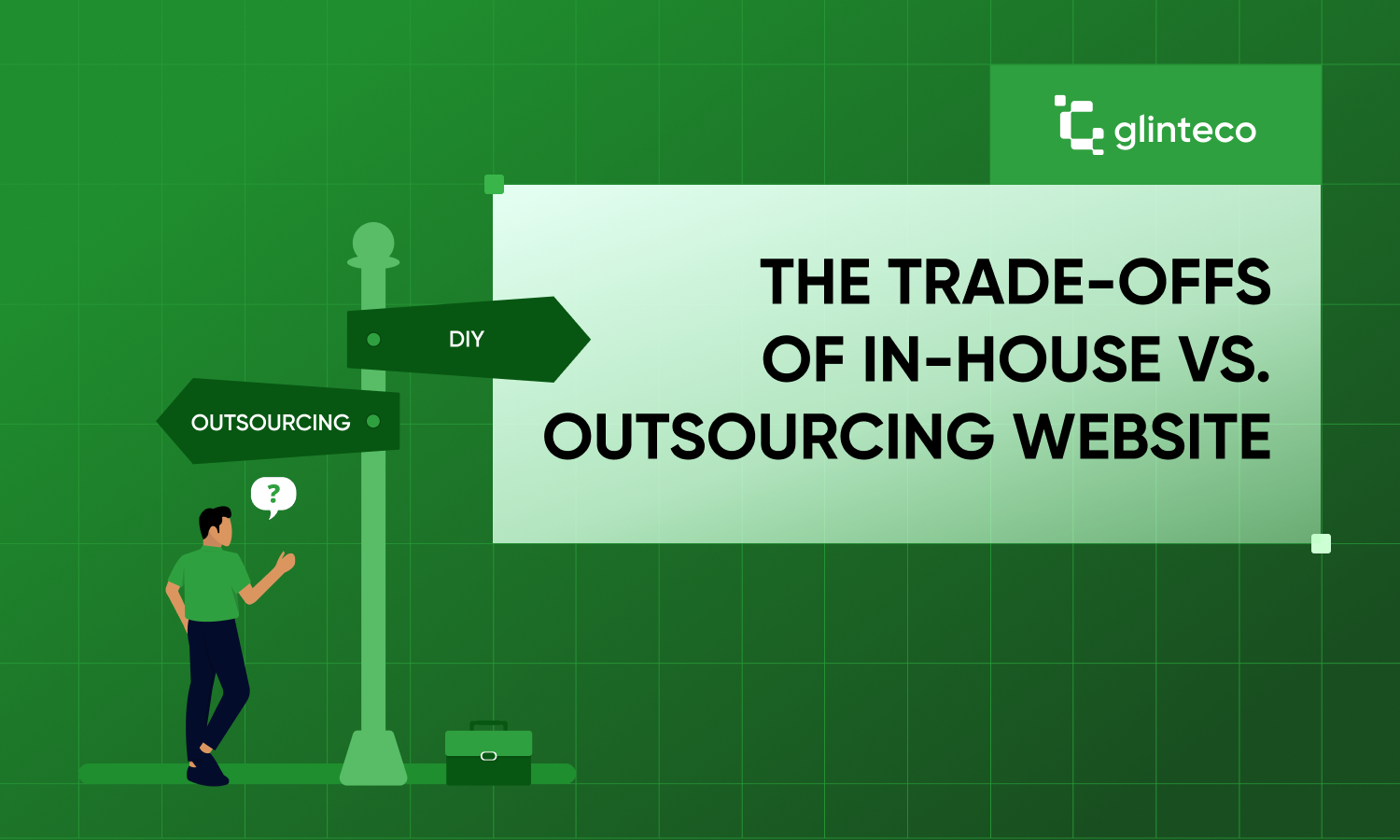
The Trade-offs of In-house vs. Outsourcing Website
By antt, at: Dec. 12, 2025, 6 a.m.
Estimated Reading Time: __READING_TIME__ minutes
For many B2B leaders in Australia, the choice between hiring an in-house developer or partnering with an agency is often reduced to a simple line item on a budget. However, the true cost of this decision extends far beyond the initial quote. This article breaks down a real-world scenario where a Melbourne-based real estate agency pivoted from a projected $120,000 in-house investment to a $50,000 strategic outsourcing partnership with Glinteco. We examine the 12-month performance data, the technical hurdles encountered, and the honest trade-offs involved in scaling a digital asset for the Australian market.
About the Author
Written by Vu Quang Hoa
With two years of academic experience in Australia and a track record of delivering complex ERP and Web App solutions for the AU, US, and SE Asia markets, Hoa bridges the gap between high-level business strategy and technical execution. He personally oversaw the digital transformation and workflow optimization for the case study discussed below.
More articles by Hoa | Connect on LinkedIn
Overview
1. The DIY (In-House) Approach
This path involves relying on internal resources, whether that's using a non-technical employee to operate a beginner-friendly platform (like Wix or Squarespace) or hiring a small, in-house web developer.
2. The Outsourcing Approach
This path involves contracting an external agency, development firm, or specialist freelancer. They take ownership of the design, development, technical maintenance, and deployment phases. Businesses can access specialised expertise (full-stack development, advanced SEO, UX/UI design), scalability, and building a custom, powerful digital asset.
The DIY (In-House) Approach
1. Advantages
- Low barrier to entry: The upfront financial cost is minimal. You typically only pay for hosting and the platform subscription.
- Total creative Control: You have direct, hands-on control over every pixel. You don't need to explain your vision to a third party.
- Agility & Speed: You can make instant updates (e.g., changing a price, fixing a typo) without logging a support ticket or waiting for an agency's turnaround time.
- Good for "MVP" (Minimum Viable Product): Ideal for testing a new business idea or product line quickly to see if there is market interest before investing heavily.
2. Disadvantages
- The "Jack of All Trades" Problem: You (or your staff) likely aren't an expert in design, coding, and SEO. The result is often a site that looks "okay" but performs poorly.
- Hidden time costs: Every hour you spend fighting with a layout or plugin is an hour taken away from sales, strategy, and running your business.
- Limited scalability: As you grow, you may find you can't integrate with your CRM, handle high traffic, or add complex custom features.
- Technical SEO deficits: Most DIY platforms have bloated code that hurts site speed . Ranking for competitive B2B keywords becomes significantly harder.
- Security vulnerabilities: Without a dedicated maintenance team, missed updates or poor plugin choices can leave your business data exposed to hackers.
3. Who should build a website themselves?
The DIY path is best suited for individuals and businesses prioritizing immediate cost savings over long-term functionality and scalability. This includes early-stage startups needing a Minimum Viable Product (MVP) for concept validation, freelancers building simple portfolios, and local service businesses requiring only a digital "calling card." In these cases, where core requirements are limited to basic information display and the budget is tight, the trade-off of sacrificing advanced SEO and customisation is justified for rapid market entry and total control over initial design.
However, thanks to the rise of "vibe coding" (leveraging AI to generate code via natural language), non-technical founders can now build fully functional, customized platforms without writing a single line of code manually. This approach is ideal for those who want total control over the design and logic but lack the budget for a professional development team. Tools like Cursor, Replit, or Lovable have democratized this process, enabling users to generate and refine complex code through simple conversational prompts. This empowers non-technical founders to focus entirely on product logic rather than syntax.
The Outsourcing Route
1. Advantages
- Access to Deep Expertise: You get a full team of experts, including UI/UX designers, backend developers, security specialists, and SEO strategists working on your project.
- Built for Scalability: Whether you have 100 visitors or 100,000, the site is engineered to handle growth without crashing.
- Advanced Technical SEO: Agencies ensure the site architecture, schema markup, and loading speeds are optimized for Google from day one, giving you a competitive edge.
- Custom Functionality: Pros can build custom solutions that DIY platforms simply cannot handle.
- Time Savings: You can focus on your core competency (running your business) while the partner handles the technical heavy lifting.
2. Disadvantages
- Higher upfront investment: Professional quality comes with a price tag. It requires a capital budget rather than just an operational expense.
- Communication overhead: Success depends on your ability to write a clear brief and communicate your needs. "Lost in translation" issues can occur if processes aren't tight.
- Loss of "Tinkering" Control: You cannot always just "drag and drop" changes instantly. Significant changes may require a change request process or developer intervention.
- Finding the right partner: The outsourcing market is crowded. It takes due diligence to find an agency that truly understands your industry and isn't just churning out templates.
While these are common challenges in the outsourcing market, they aren't inevitable. Glinteco bridges this gap by offering:
- Cost-Efficiency: We offer professional quality at a highly competitive price point compared to local native agencies.
- Cultural & Language Fit: Communication is seamless. Our team is proficient in English, and our leadership (with our CEO having studied in Australia for 2 years) ensures we understand your cultural and business context perfectly.
- Restored Control: We don't lock you out. We provide thorough training, including video guides and documentation, making it easy for your internal team to handle future edits.
- Commitment to Impact: We move beyond simple deliverables to guarantee the final results and operational efficiency of your project.
3. Why is outsourcing the superior choice for growth?
Outsourcing is a strategic investment for B2B businesses focused on scaling and maximizing digital performance. By partnering with specialized agencies, you immediately gain access to advanced technical expertise (development, security, and advanced SEO) that is too costly and difficult to maintain in-house. This approach converts high, fixed overhead costs into predictable, project-based expenditures, significantly reducing the business owner's time drain and ensuring the final website is a high-performing, secure, and future-proof asset engineered for sustained lead generation and integration with complex business systems.
Comparison between DIY (in-house) and Outsourcing website
Criteria |
DIY / In-House |
Outsourcing |
|---|---|---|
Initial Cost |
Low / Subscription-based | High / Upfront Capital |
Ongoing Cost |
Low (Hosting/Plugins) | Moderate (Retainers/SLAs) |
Time Investment |
High (Learning & Building) | Low (Briefing & Reviewing) |
Expertise Level |
Generalist / Self-Taught | Specialist / Expert Team |
Customisation |
Template-bound / Limited | Unlimited / Custom Code |
Scalability |
Low / Platform-dependent | High / Enterprise-ready |
SEO Capability |
Basic / On-page | Advanced / Technical |
Launch Speed |
Fast (for simple sites) | Moderate (process-driven) |
Security Risk |
High (Self-managed) | Low (Proactive/Monitored) |
Best Fit For |
Startups / MVPs / Blogs | SMEs / Enterprises / SaaS |
Outsourcing stories
Many assume that industry giants built everything in-house from day one. In reality, successful market leaders treat outsourcing as a strategic lever to accelerate growth, not just a way to cut costs. Here is how outsourcing laid the foundation for billion-dollar successes, and how Glinteco applies that same formula for our clients.
- Slack: Outsourced their entire branding and interface design to ensure a world-class user experience from day one. This allowed them to focus entirely on backend logic, a key strategy that helped them become the fastest startup to reach a $1B valuation.
- Alibaba: Jack Ma outsourced early development to the US to access global talent and they had built the foundation for the world’s largest IPO ($25B).
- GTA (Growth Team Advisory): Partnered with Glinteco to overhaul a cluttered legacy site. Result: Achieved a mobile-first, high-performance platform with significantly improved SEO and user engagement. Read more about GTA’s story at:
The $120,000 Dilemma: The Hidden Costs of Going In-House
Our client initially planned to hire two senior developers to build their custom property management and CRM system. In the Melbourne market, the math seemed straightforward but daunting: base salaries, superannuation, and equipment costs totaled an estimated $120,000 for the first year alone. Beyond the financial burden, the agency faced a "Single Point of Failure" risk—if a lead developer left mid-project, the institutional knowledge would vanish. They quickly realized that while an in-house team offers proximity, it often lacks the multi-disciplinary expertise (UI/UX, Security, and SEO) required to build a future-proof platform from scratch.
The Strategic Pivot: A $50,000 Targeted Partnership
After auditing their internal workflows, Glinteco proposed a different route. Instead of high fixed overheads, we implemented a $50,000 structured development phase followed by a proactive maintenance retainer. Our approach didn’t just focus on "writing code"; we performed a deep Business Process Audit to identify data silos between their sales and accounting departments. By leveraging our established tech stack (Django/ReactJS) and pre-built modules, we were able to deliver a high-performance system at 40% of their original projected cost.
12-Month Results: Performance Over Promises
A year after deployment, the numbers told the real story. The agency achieved a 70% increase in data accuracy across their commission and sales tracking modules. Operationally, the automated reporting features saved the administrative team approximately 20 hours per week, time that was redirected toward high-value client relations. Furthermore, the platform was engineered for scalability; unlike a "bloated" DIY site, the custom architecture maintained a sub-2-second load time even as their property listings grew by 300%.
The Honest Trade-Offs: Lessons Learned
Outsourcing is not a "set and forget" solution. In the interest of transparency, the agency noted two primary challenges during the transition. First, there was a loss of "instant tinkering" control; changes that once felt immediate now required a formal ticket and quality assurance process. Second, the initial onboarding required significant time from the agency’s leadership to define the business logic. However, these were considered "productive frictions", ensuring that every update was intentional, secure, and aligned with long-term SEO and performance goals rather than just a quick fix.
Human Insights: Is Outsourcing Right for Your Growth?
The lesson from this Melbourne agency is clear: Don’t outsource just to save money; outsource to buy back time and access specialized expertise. While a DIY approach or a small in-house team might suffice for a "Minimum Viable Product," scaling requires a "Digital Engine" that can handle the heavy lifting. By converting high fixed costs into predictable, result-oriented investments, you empower your business to focus on its core competency: innovation and sales.
Conclusion
The choice between DIY and outsourcing is ultimately a decision about where you allocate your resources and risk.
While the low initial cost of a DIY website is tempting, for any B2B business committed to long-term, scalable growth, the hidden costs - the drag on technical performance, the severe limits to custom integration, and the irreplaceable drain on the owner's time: quickly outweigh the savings.
Need a truly user-centric, high-converting digital platform? Glinteco is your One-stop Tech Solution. We provide comprehensive services in UI/UX, mobile application development, web application development, Artificial Intelligence (AI) and Machine Learning (ML). We are committed to delivering high-performance applications that make use of the latest AI and ML technologies to ensure your platform not only works perfectly but converts beautifully.
Make the strategic investment today to free your team to focus on innovation and sales, and let specialized partners ensure your digital engine is powerful enough to drive the growth you demand.