The Yes Paradox: Mastering Communication and Feedback with Your Vietnamese Team
By dunghv, at: Dec. 1, 2024, 4:46 p.m.
Estimated Reading Time: __READING_TIME__ minutes
If you have managed an offshore Vietnam software development team, you have likely encountered the "Yes Paradox." You ask a developer if a complex feature can be delivered by Friday. They smile, nod, and say, "Yes." Friday arrives, the feature is missing, and you are left wondering if there was a lapse in honesty or competence.
As a veteran of both Silicon Valley product cycles and Southeast Asian engineering hubs, I can tell you: it is neither. What you encountered was a sophisticated cultural algorithm known as "Saving Face" (giữ thể diện). In the high-stakes world of global IT, understanding this paradox is the difference between a project that scales and one that stalls.
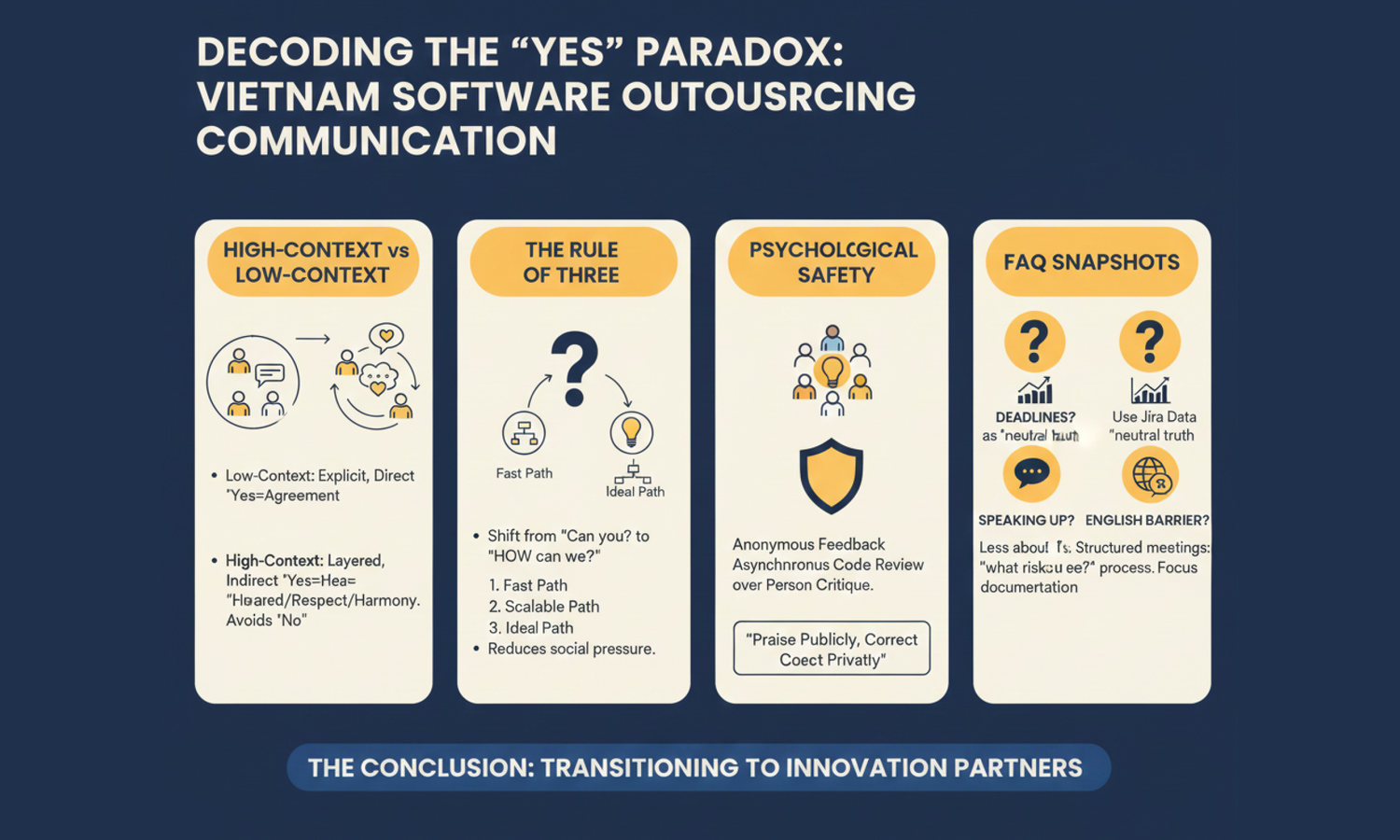
Decoding the "Yes": High-Context vs. Low-Context
To manage an offshore IT team effectively, you must understand the work of anthropologist Edward T. Hall on high-context vs. low-context cultures. Western cultures (the US, Australia, Germany) are "Low-Context." We prioritize explicit verbal instructions. We say exactly what we mean.
Vietnam is a "High-Context" culture. Communication is layered. A "Yes" often doesn't mean "I agree the task is technically feasible by Friday." It often means:
-
"I hear you"
-
"I respect your authority as a leader"
-
"I want to maintain harmony in this meeting"
In this framework, saying "No" in a public meeting is seen as a "loss of face" for both the developer (who appears incapable) and the manager (who appears to have made an unreasonable request). To bridge this communication in outsourcing gap, you must change how you ask, not just what you ask.
Moving from "What" to "How": The Rule of Three
One of the most effective strategies I’ve implemented to bypass the "Yes Paradox" is the Rule of Three. Instead of asking a binary question ("Can you do this?"), ask for three distinct execution paths.
Example: "Instead of telling me if this is possible, could you show me three ways we could approach this architecture? One 'fast' way, one 'scalable' way, and one 'ideal' way."
By shifting the focus from a "Yes/No" binary to a multi-option technical discussion, you remove the social pressure to "Save Face". You give the developer the psychological safety to highlight risks under the guise of "evaluating trade-offs". This aligns perfectly with Agile in Vietnam, where the goal is rapid iteration based on honest technical feedback.
Engineering Psychological Safety in Code Reviews
In many Vietnamese education systems, hierarchy is strictly respected. This can lead to a "Seniority Bias" where junior developers are hesitant to point out flaws in a senior’s code. In a modern IT workforce, this is a recipe for technical debt.
To solve this, professional teams adopt Asynchronous and Anonymous Feedback loops. Tools like GitHub’s pull request system are a godsend here. When feedback is written rather than spoken, and framed as a "Review of the Code" rather than a "Critique of the Person," the cultural barrier to directness vanishes.
The Professional Insight: Use the "Praise Publicly, Correct Privately" rule. If you must deliver hard feedback, do it in a 1-to-1 setting. Publicly correcting a developer in a Zoom call with 10 people will cause them to "shut down" to protect their social standing.
Frequently Asked Questions (FAQs)
Does the "Yes Paradox" mean I can't trust my team's deadlines?
Not at all. It means you need to validate the "Yes" with data. Use your Jira burndown charts and automated sprint reports as the "Source of Truth." If the data says a task is behind but the developer says "Yes," use the data as the neutral third party to start the conversation: "The chart shows we're at 40%, how can we unblock this?"
How do I encourage my Vietnamese developers to speak up in meetings?
Structure your meetings. Instead of asking "Does anyone have questions?", call on individuals by name for specific technical input: "Long, based on your work with the API, what is the biggest risk you see here?" Giving a developer the "floor" explicitly makes it their responsibility to share knowledge rather than an act of "interrupting."
Is English proficiency the root cause of these communication gaps?
Rarely. While English proficiency in Vietnam has seen steady improvement, the "Yes Paradox" exists even among fluent speakers. It is a social operating system, not a linguistic one. Focus on the process of feedback, not just the vocabulary.
What is the best way to handle a missed deadline?
Avoid "Blame Language." Instead of "Why didn't you tell me you were behind?", use "The timeline shifted. What were the technical dependencies that took longer than expected?" This invites a technical post-mortem rather than a personal defense.
The Conclusion: Transitioning to Innovation Partners
When you master the nuances of Vietnamese communication, your team stops being "executors" and starts being Innovation Partners. By creating a culture of psychological safety and using the right management frameworks, you unlock the full power of that "Mathematical DNA" we discussed here