Website Is Not Design: A Strategic Framework for SME Growth
By antt, at: Jan. 7, 2026, 6 a.m.
Estimated Reading Time: __READING_TIME__ minutes
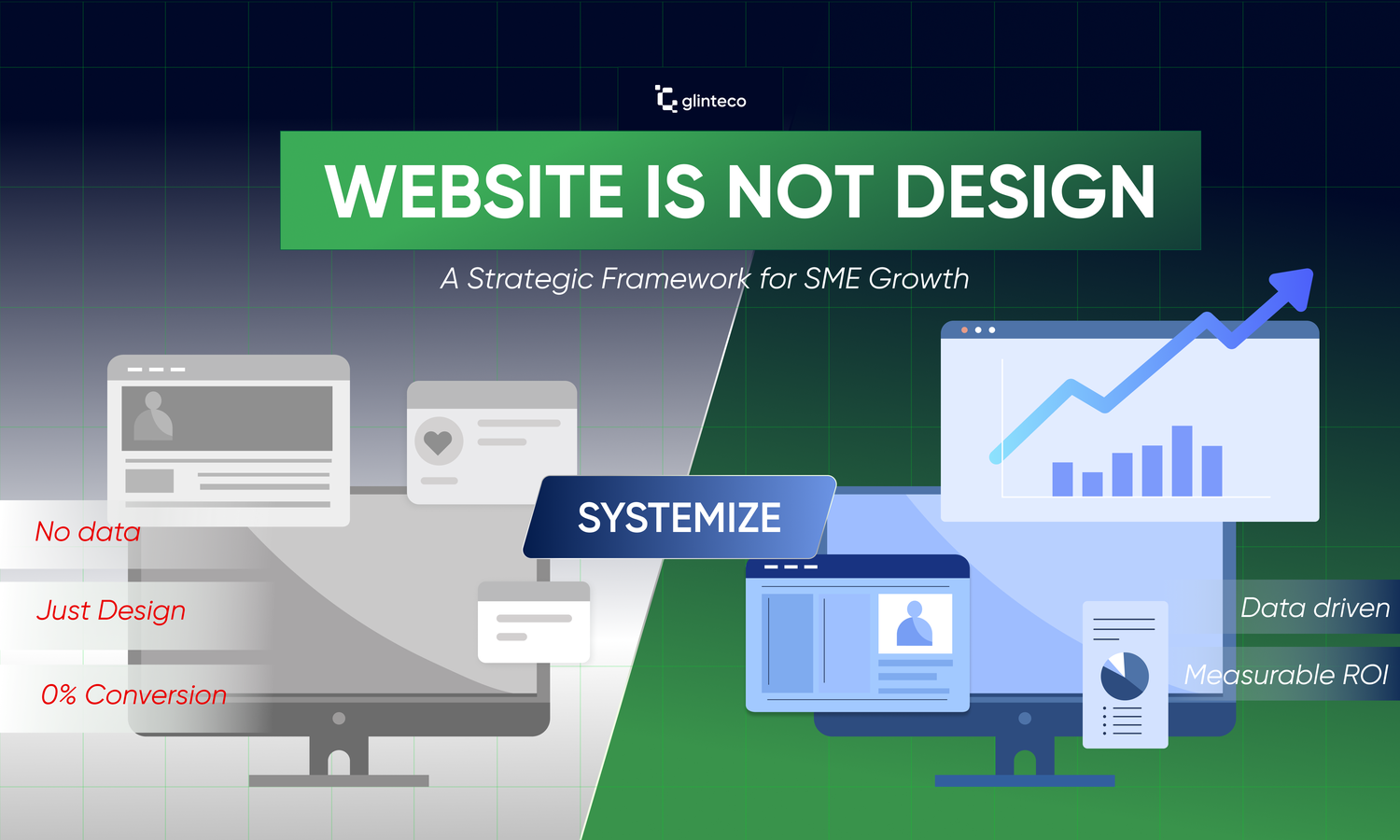
In 2023-2024, Glinteco built three websites with very different outcomes. Vietnam Women's Museum spent $10K and saw 130% traffic growth. DKG Hospitality spent $15K on beautiful design but bookings dropped 40%. Paradisehome.vn managed 1,000+ rooms but loaded in 8.7 seconds, losing 71% of mobile visitors. This case study reveals why websites fail not from poor design but from missing systematic thinking across UX, performance, conversion, and data layers and the framework we built to fix it.
About the Author
Written by Vu Quang Hoa
Vu Quang Hoa is CEO and Founder of Glinteco, with 8 years building web systems for SMEs across Australia, Japan, Vietnam, and the USA. This article draws from three projects between 2020-2024: Vietnam Women's Museum redesign, DKG Hospitality hotel platform, and Paradisehome.vn property system. The 4-Layer Framework discussed here evolved directly from failures across these projects.
More articles by Hoa | Connect on LinkedIn
Part 1: When Success Breeds Failure
In 2020, we redesigned Vietnam Women's Museum's website, a digital archive of cultural artifacts and heritage stories. We rebuilt it on WordPress with interactive virtual tours, audio descriptions, and mobile-optimized galleries for $10,000 over six months. Three months after launch, traffic jumped 130%, bounce rate dropped 45%, and time on site increased 60%. The museum director told us it was "completely a revolution."
We thought we'd mastered cultural websites. Then DKG Hospitality hired us in 2023.
DKG Group owned multiple high-end hotels across Vietnam. They wanted something matching their luxury brand. We delivered exactly that: stunning property photography, smooth animations, elegant typography, and mobile-responsive design. Investment: $15,000 over five months using Django, Django CMS, and VueJS with Redis caching.
Week one post-launch, the client loved it. We invoiced and moved to the next project. Week four, DKG's operations director emailed: "The site is beautiful, but bookings haven't increased. Actually, our booking-to-inquiry ratio dropped from 18% to 11%. What happened?"
Simultaneously, we were building Paradisehome.vn, a booking platform managing 1,000+ rooms across 15 buildings in Hanoi. During testing with 200 rooms, everything worked smoothly at 2.1 seconds page load. When we loaded all 1,000+ rooms into production, mobile load time hit 8.7 seconds. The system occasionally timed out during peak evening hours when people searched for apartments after work. Analytics showed 63% mobile traffic, 71% bounce before page finished loading, and 1.2% inquiry rate against a 3-5% industry standard.
We had built beautiful, functional websites. Both failed as business systems.
Part 2: What We Got Wrong
Our museum success came from beautiful UI, interactive features, mobile design, and easy content management. This worked because museum visitors weren't converting to transactions, they were consuming content. Engagement and accessibility were enough.
When we applied the same thinking to DKG, we focused on beautiful design, smooth interactions, and modern aesthetics. We missed that DKG's metrics should have been booking inquiry rate, inquiry-to-booking conversion, revenue per visitor, and occupancy rate driven by web traffic. What we built was a digital brochure with generic "Contact Us" CTAs, forms buried three clicks deep, no value proposition, no A/B testing, and zero analytics on funnel drop-off.
For Paradisehome, we focused on feature completeness: room search with filters, availability calendar, booking flow, CMS updates, and real-time sync. What we didn't prioritize was performance under actual load with 1,000 rooms, mobile optimization beyond responsive design, database query optimization, image optimization for 15+ photo galleries per property, or load testing with concurrent users.
After DKG's director showed us the booking drop-off data and Paradisehome's owner complained about slow searches, we realized we'd been building websites, not conversion systems. We were great at UI/UX, frontend engineering, content management, and feature implementation. We were weak at conversion optimization, performance engineering under load, data-driven decision making, and systems thinking.
Part 3: The 4-Layer Framework
We rebuilt our approach from "What should it look like?" to asking what business outcome the website must drive, what user journey leads there, what technical system enables that journey at scale, and what data tells us if it's working. This became our 4-Layer Framework.
The UX Layer focuses on user journey optimization, not just interface beauty. The museum succeeded because users wanted to explore content: homepage to exhibitions to artifacts to virtual tours worked perfectly. DKG failed because users wanted to book rooms for specific dates, but we provided no clear path. The fix was Homepage to "Check Availability" to Select Property to View Rooms to Book. UX design must be goal-specific, not aesthetic-first.
The Performance Layer treats speed as foundational to conversion, not optional polish. Paradisehome data showed at 8.7 seconds load time, 71% bounced. At 2.1 seconds, only 38% bounced. With 1,000 daily visitors, that 33% retention meant 330 extra visitors, generating 16 extra inquiries daily or 480 monthly. According to Google's research on mobile page speed, 53% of mobile users abandon pages taking longer than three seconds. Performance optimization isn't a nice-to-have, it's conversion infrastructure.
The Conversion Layer makes every element serve conversion with context-specific CTAs matching user intent. DKG's initial site had "Learn More" on the homepage and "Contact Us" on property pages, achieving 11% inquiry rate. After rebuild, we used "Check Availability for [Your Dates]" on homepage, "View Rooms & Rates from $120/night" on property pages, and "Book This Room" plus "Questions? Chat on WhatsApp" on room pages. Inquiry rate jumped to 23%. CTAs must tell users exactly what happens next and why they should click.
The Data & Tracking Layer measures everything that matters with metrics tied to business outcomes. Before rebuilds, we tracked pageviews, bounce rate, and traffic sources but used nothing actionably. After, the museum tracked exhibition page views per session, virtual tour completion rate, and mobile versus desktop engagement. DKG tracked homepage to property to room to booking funnel drop-off, inquiry form abandonment by field, CTA click-through rates, and revenue per visitor. Paradisehome tracked search performance by time of day, filter usage patterns, mobile versus desktop conversion, and load time correlation with bounce rate. Data without strategy is noise, define KPIs first, then track relentlessly.
Part 4: The Rebuilds
For DKG Hotel over six weeks, we absorbed the $8,000 rebuild cost ourselves. We removed generic "Contact Us" and added "Check Availability for [Date Range]," placed "Book Your Stay" above fold on homepage, added trust signals like "4.8/5 rating from 240 guests," and built a multi-step booking flow with progress indicators. Research from Nielsen Norman Group on form usability shows that breaking long forms into steps significantly improves completion rates. We implemented exit-intent popups offering 10% off first bookings and added WhatsApp buttons for instant inquiries since Vietnamese users prefer chat. We set up Google Analytics 4 with enhanced ecommerce tracking, conversion funnels showing homepage to property to room to booking to confirmation, and A/B tested CTA language.
Results three months later showed booking inquiry rate increased from 11% to 23% (up 109%), form completion rate from 34% to 67% (up 97%), time to inquiry dropped from 4 minutes 30 seconds to 2 minutes 10 seconds (down 52%), and mobile bookings grew from 18% to 41% of total (up 128%). WhatsApp inquiries added a new channel at 12 per day. Monthly web-driven bookings jumped from 23 to 61 (up 165%). With average booking value of $180 per night and 2.3 average nights, additional monthly revenue reached $15,732 against zero client investment since we absorbed the rebuild cost.
For Paradisehome over 12 weeks at $8,500 shared with the client, we prioritized performance overhaul. Similar to our approach rebuilding legacy systems incrementally, we added database indexes on location, price range, and availability fields, implemented Redis caching with 15-minute time-to-live, and reduced queries per page from 847 to 12. We compressed images from average 3.2MB to 180KB using TinyPNG, implemented lazy loading, and used progressive JPEGs. We reduced JavaScript bundle size from 2.1MB to 420KB, implemented code splitting, and used pagination showing 20 rooms at a time instead of 1,000. We simplified filters from eight options to four essential ones, added "Book Viewing" CTAs on every room card, and set up real-time performance monitoring with alerts triggered if page load exceeded three seconds.
Results four months later showed mobile page load dropped from 8.7 seconds to 2.1 seconds (down 76%), bounce rate from 71% to 38% (down 46%), and search-to-inquiry rate jumped from 1.2% to 4.8% (up 300%). Viewing bookings per month increased from 47 to 183 (up 289%) while system timeouts dropped from 15-20 daily to 0-1 daily (down 95%). Monthly inquiries grew from 89 to 356 (up 300%). With 18% historical inquiry-to-lease conversion, this meant roughly 48 additional leases monthly. At average lease value of $450 monthly times six month average stay equaling $2,700, additional monthly value reached $129,600. The $8,500 investment was covered 15 times over in the first month.
Part 5: Why Most SME Websites Fail
The "brochure mindset" assumes looking professional equals driving business outcomes. DKG's initial site looked professional but failed at driving bookings because they hired designers, not conversion strategists. Agencies focus on portfolio pieces while no one asks what specific business outcome must change in six months.
Fragmented technology prevents system thinking. Before Paradisehome rebuild, the website was custom Django, booking happened via phone and email, CRM lived in Excel spreadsheets, and analytics had no goal tracking. As we explored in our analysis of integrated development processes, zero visibility into the funnel meant no optimization. After integration, we could see exactly where users dropped off and optimize systematically.
Treating websites as costs instead of assets leads to "build once, maintain minimally, expect it to work forever" thinking. The museum trained staff to update content weekly with new exhibitions, events, and stories. Traffic grew 130% over 12 months because content stayed fresh. After DKG's rebuild, we conducted quarterly reviews analyzing holiday booking patterns, A/B testing pricing display, and adding loyalty program messaging when the client launched it. Continuous improvement beats static sites.
Ignoring performance means ignoring revenue. Office testing showed DKG working perfectly on fast WiFi and desktop. Real users were on mobile 3G/4G loading in 8.7 seconds with 71% bouncing. According to Cloudflare's analysis of page load impact, pages loading in 2.4 seconds achieve 1.9% conversion rates while pages at 3.3 seconds drop to 1.5%—a seemingly small difference that compounds dramatically at scale. SMEs miss this because they don't load test with real conditions, monitor performance post-launch, or realize responsive design doesn't equal mobile-optimized. Test on real devices with real networks and monitor continuously.
Part 6: How We Apply It Now
Every website project starts with discovery defining the number-one business outcome, success conversion rate, user context, and current funnel analysis if a site exists. This discovery defines everything: UX flow, performance targets, conversion elements, and tracking setup.
Design phase starts with user journey mapping before pixels. For DKG, we mapped landing from organic search to hero CTA "Check Availability" to inline date selector to filtered properties to property detail to "View Rooms & Rates" to room selection to "Book This Room" to minimal guest details form to booking confirmation via email and WhatsApp. Only after mapping this journey do we design UI serving the journey, not aesthetic preference.
Development phase builds performance into architecture from day one. For Paradisehome, we indexed all searchable fields, denormalized read-heavy data to avoid joins, cached frequent queries with 15-minute Redis TTL, implemented code splitting with separate bundles for homepage and search, optimized images with WebP format and lazy loading, used Celery for async email notifications, paginated to load 20 results at a time, and optimized queries to 12 per page. Real-time alerts trigger if page load exceeds three seconds with weekly performance reports and session recordings showing real user experience.
Post-launch phase emphasizes data-driven iteration, not "launch and leave." As discussed in how we measure development team performance, for DKG in the first 90 days, weeks one through two established baseline data on traffic sources, behavior, and funnel drop-off. Weeks three through four discovered 40% dropped at "Guest Details" with too many fields. Reducing from eight to four fields raised form completion from 34% to 52%. Weeks five through eight A/B tested "Book Now" versus "Check Availability" on property pages, with "Check Availability" winning by 18% higher click-through rate because users wanted to see rooms and rates before committing. Weeks nine through 12 addressed 60% mobile bounce rate versus 30% desktop by increasing touch target sizes and mobile-optimizing form layout, dropping mobile bounce to 35%.
This continuous iteration explains why results improved over three months rather than immediately.
Conclusion: From Brochures to Systems
The museum's success, DKG's initial failure, and Paradisehome's performance crisis taught us websites are system engineering projects, not design projects. Treating them as visual exercises succeeded with content sites but failed with transactional sites. Shifting to system thinking—integrated layers of UX, performance, conversion, and data—transformed DKG from 11% to 23% inquiry rate and Paradisehome from 8.7 seconds to 2.1 seconds load time with 300% conversion increase.
The 4-Layer Framework is now our approach: journey mapping before mockups, engineering for speed from day one, making every element serve conversion, and measuring what matters. This isn't theory—it's what we learned from $25,000 in absorbed rebuild costs across 1,000+ rooms, 15+ properties, and three industries.
Ready to Build a System, Not a Brochure?
Contact Glinteco for a Website System Audit evaluating your site across all four layers with specific improvement opportunities.