Why AI-Built Websites Fail When Businesses Start to Scale
By vunh, at: April 2, 2026, 10:44 a.m.
Estimated Reading Time: __READING_TIME__ minutes


In the past two years, AI-powered website builders have significantly lowered the barrier to entry for businesses. What used to take weeks of design and development can now be done in minutes. For early-stage teams or quick experiments, this is undeniably valuable.
However, a recurring pattern has started to emerge.
Websites generated by AI often perform adequately at launch, but begin to break down as soon as the business behind them starts to grow. The issue is not that these tools are ineffective. It is that they are optimised for speed and accessibility, while real businesses operate on entirely different requirements, including differentiation, usability, and long-term scalability.
This mismatch becomes increasingly visible over time.
The illusion of “good enough” design
At first glance, most AI-generated websites appear acceptable. They follow modern layout conventions, maintain visual consistency, and avoid obvious design flaws. For many founders, especially those without a design background, this creates the impression that the problem of “having a website” has been solved.
But design, in a business context, is not about avoiding mistakes. It is about creating distinction.
AI-generated websites tend to rely heavily on existing design patterns. Colour palettes are safe and neutral, typography is predictable, and animation is minimal or generic. The result is a surface-level polish without any underlying identity. The website looks functional, but it does not communicate anything specific about the brand.
This becomes a problem in competitive markets.
When multiple companies use similar tools, their outputs begin to converge. The differences between websites become marginal, and from a user’s perspective, interchangeable. In such environments, memorability drops, and with it, trust and conversion potential. Users may not consciously analyse design, but they react to it instantly. If nothing stands out, nothing is retained.
The core issue is that AI can replicate structure, but it cannot originate positioning. Without deliberate design direction, the website becomes a template filled with content, rather than a system that expresses a brand.
Standardisation as a hidden cost
The appeal of AI website builders is largely tied to efficiency. They reduce time, cost, and dependency on technical resources. However, this efficiency is achieved through standardisation.
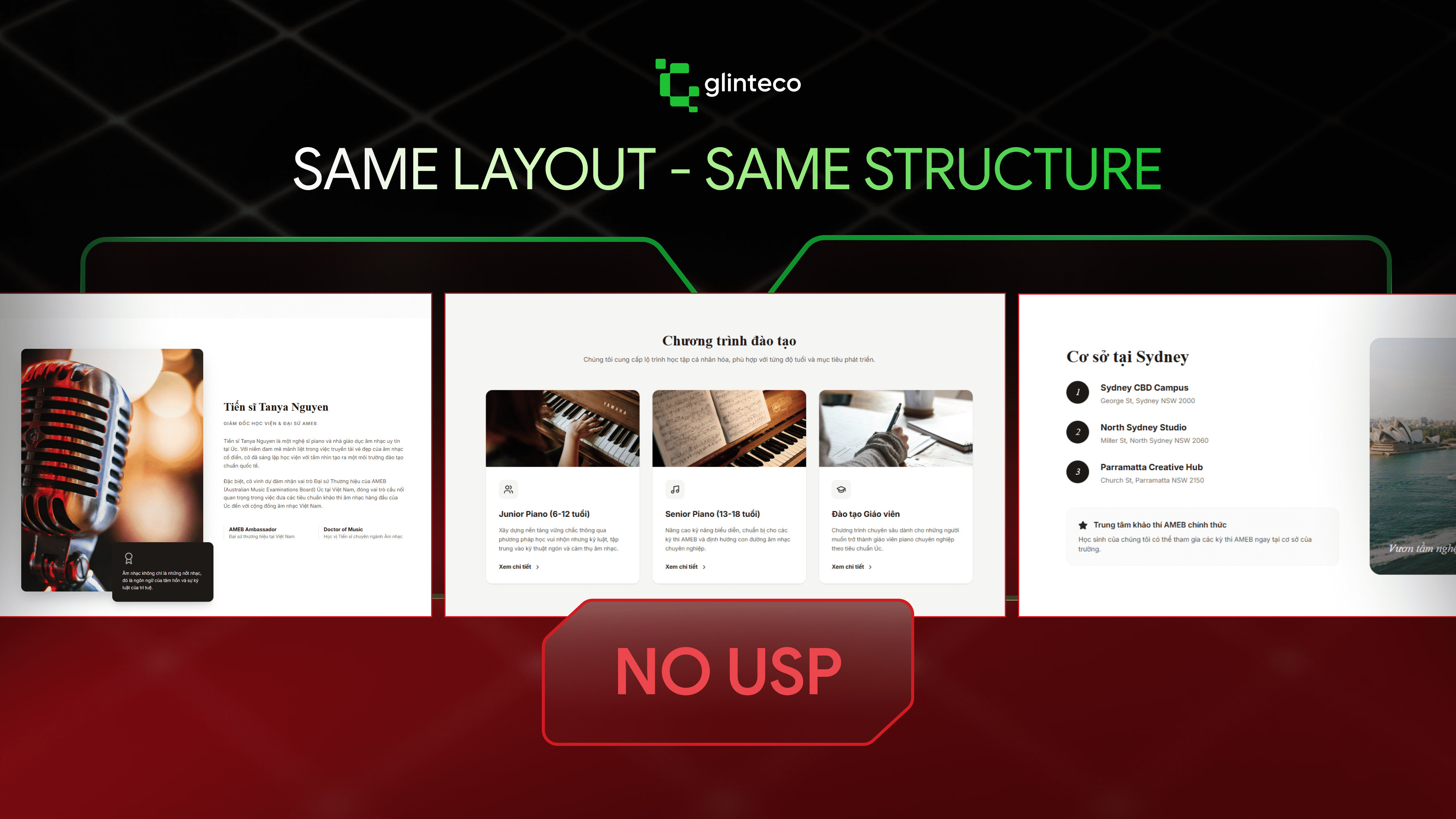
Most AI-generated websites are built on similar structural logic. Sections are arranged in familiar patterns, content blocks follow predefined hierarchies, and interaction models are reused across different sites. While this ensures usability, it also removes uniqueness.
From a business perspective, this creates a subtle but critical problem.
Brand perception is influenced not only by messaging, but by presentation. If a company’s website looks indistinguishable from others in its category, it weakens its ability to position itself differently. This directly impacts pricing power, perceived quality, and customer trust.
In other words, what begins as a cost-saving decision at the product level can translate into a positioning problem at the market level.
This is particularly evident in industries where digital presence plays a central role in decision-making. When users compare multiple providers and encounter similar-looking websites, differentiation must come from elsewhere. In many cases, it does not, leading to commoditisation.
The irony is that the very tools designed to accelerate growth can, in practice, flatten competitive advantage.
Breakdown under real usage conditions
Another limitation becomes apparent not at launch, but during ongoing use.
AI-generated websites are typically optimised for initial setup rather than long-term operation. This distinction is often overlooked. A website is not a static asset. It is a working system that needs to support content updates, feature changes, and evolving user behaviour.
In practice, teams frequently encounter friction when attempting to extend or modify AI-built sites. Content management, particularly for blogs or dynamic sections, can feel rigid. Customisation options are limited or unintuitive. Layout changes that appear simple may introduce inconsistencies or require workarounds.
Over time, these constraints accumulate.
Instead of enabling faster iteration, the system begins to slow teams down. Time is spent navigating limitations, fixing recurring issues, or compensating for missing flexibility. In some cases, performance issues or integration failures emerge as traffic increases or additional tools are connected.
This leads to a familiar outcome.
The initial speed advantage is offset by growing technical debt. Eventually, many teams reach a point where rebuilding becomes more efficient than continuing to patch the existing system.
From a technical standpoint, this reflects a deeper issue. AI tools are designed to generate outputs quickly, but not necessarily to support complex, evolving architectures. Scalability requires intentional system design, not just assembly.

The underlying mismatch
The common thread across these challenges is not a flaw in AI itself, but a mismatch in expectations.
AI is highly effective as a tool. It accelerates processes, reduces manual effort, and lowers entry barriers. However, it does not replace the need for strategic thinking in product and system design.
Businesses do not operate in static conditions. They grow, adapt, and compete. Their digital infrastructure must do the same. This requires decisions that go beyond layout and content generation, including how a system reflects brand identity, supports user interaction, and scales with demand.
When AI is treated as a complete solution rather than a component, these considerations are often neglected.
A more sustainable approach
A more effective approach is not to reject AI, but to reposition it.
AI can be used to accelerate certain aspects of development, particularly in early stages or for specific tasks. However, the overall system still needs to be designed with long-term objectives in mind. This includes building flexible architectures, defining clear design direction, and ensuring that user experience is aligned with actual usage patterns.
This is where experienced product and engineering teams play a critical role.
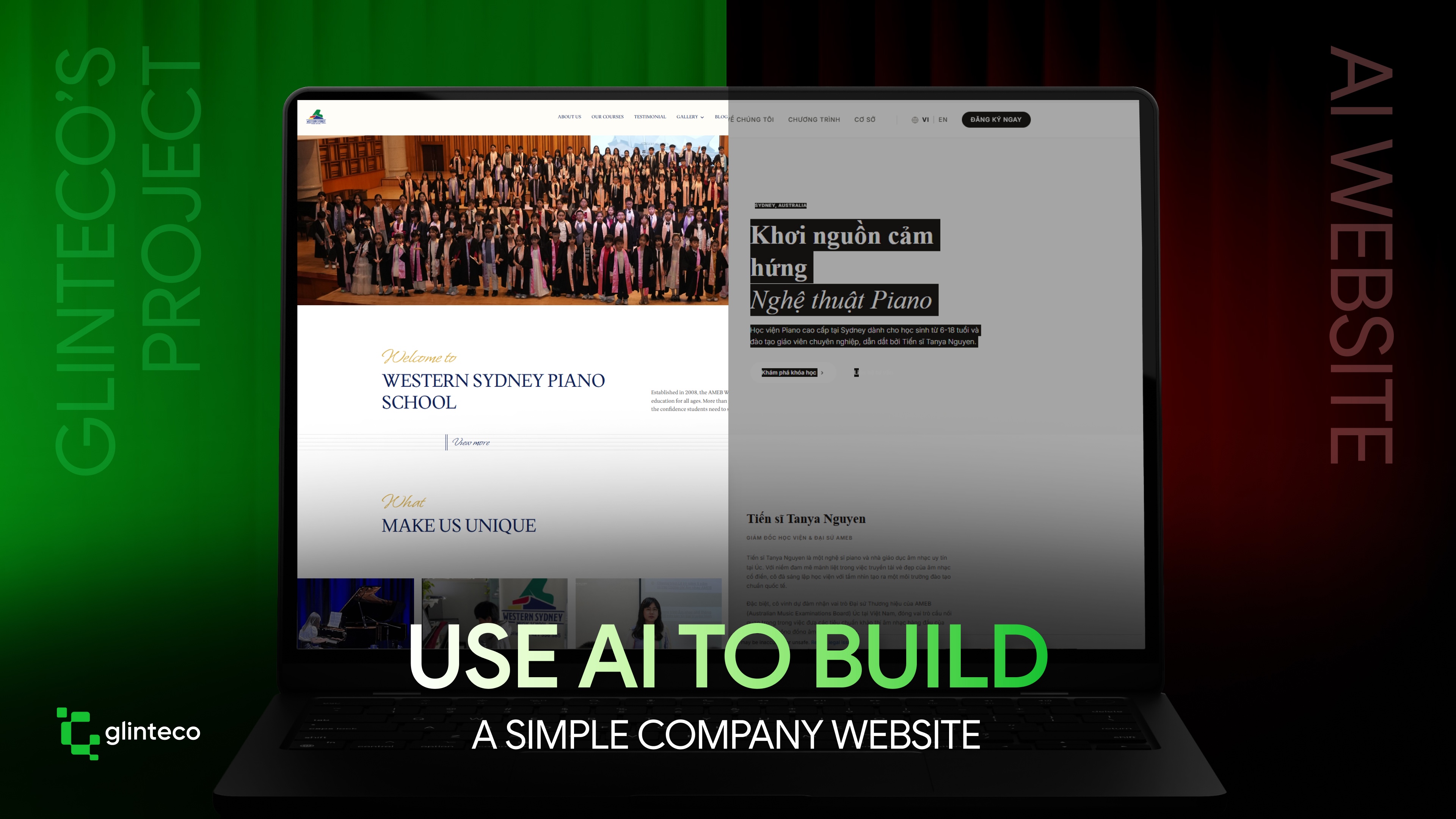
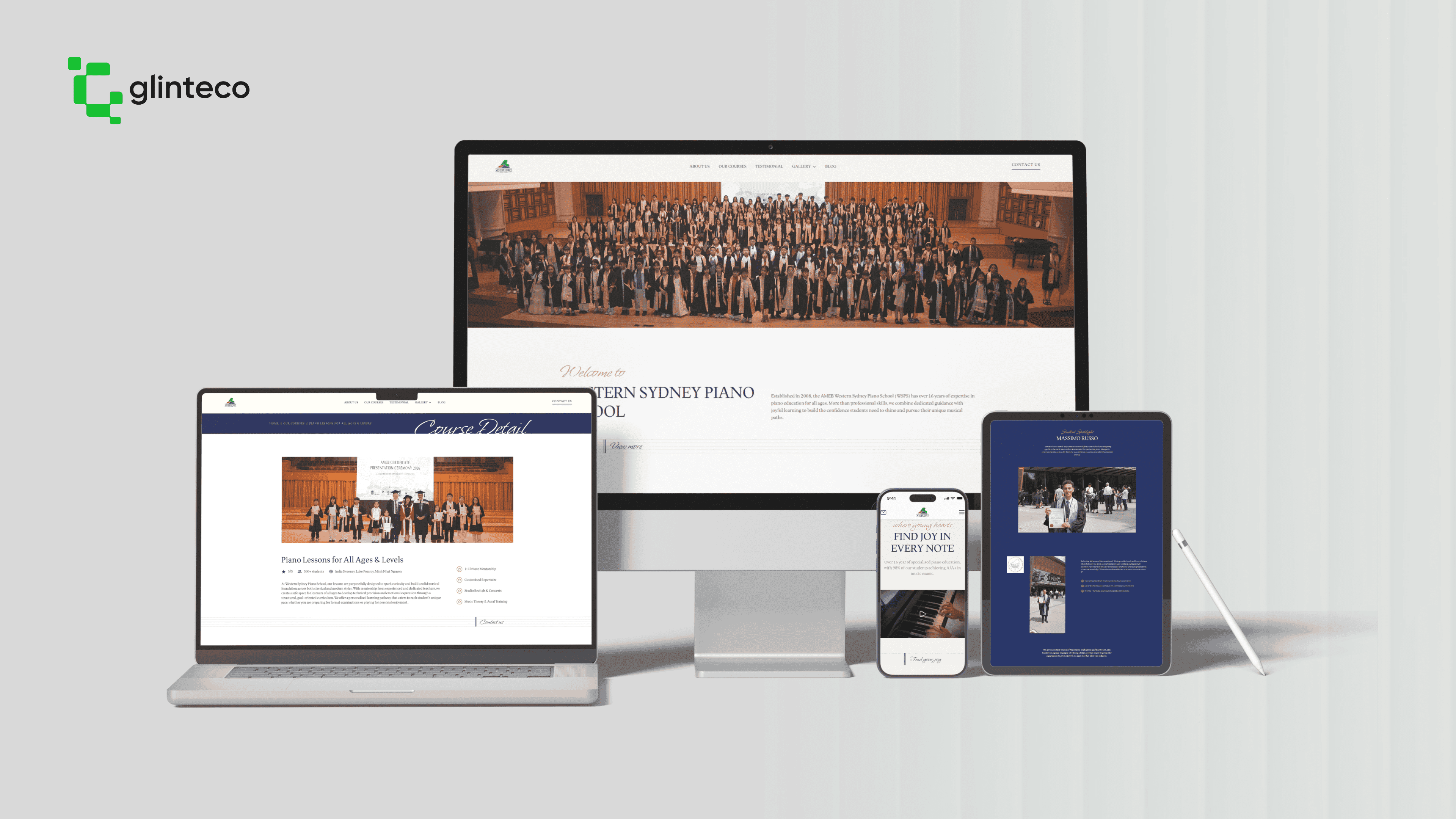
At Glinteco, AI is integrated as part of the workflow, not as a replacement for it. The focus remains on building systems that are tailored to each business, capable of evolving over time, and grounded in real user needs. Projects such as Western Sydney Piano School platforms illustrate how combining technical depth with design intent can produce outcomes that are both functional and distinctive.
Conclusion
AI has fundamentally changed how quickly websites can be created. What it has not changed is what makes them effective.
For businesses that require only a basic online presence, AI-generated solutions may be sufficient. But for those that rely on their website as a core part of growth, whether for branding, conversion, or product delivery, the limitations become difficult to ignore.
Scaling is not simply about doing more of the same. It is about building systems that can handle complexity without losing clarity.
And Glinteco is a reliable, dedicated, and enthusiastic long-term support partner you can choose.