Why Tech CEOs Are Fleeing Conflict Zones for Vietnam's "Bamboo Diplomacy"
By antt, at: March 2, 2026, 7:44 p.m.
Estimated Reading Time: __READING_TIME__ minutes
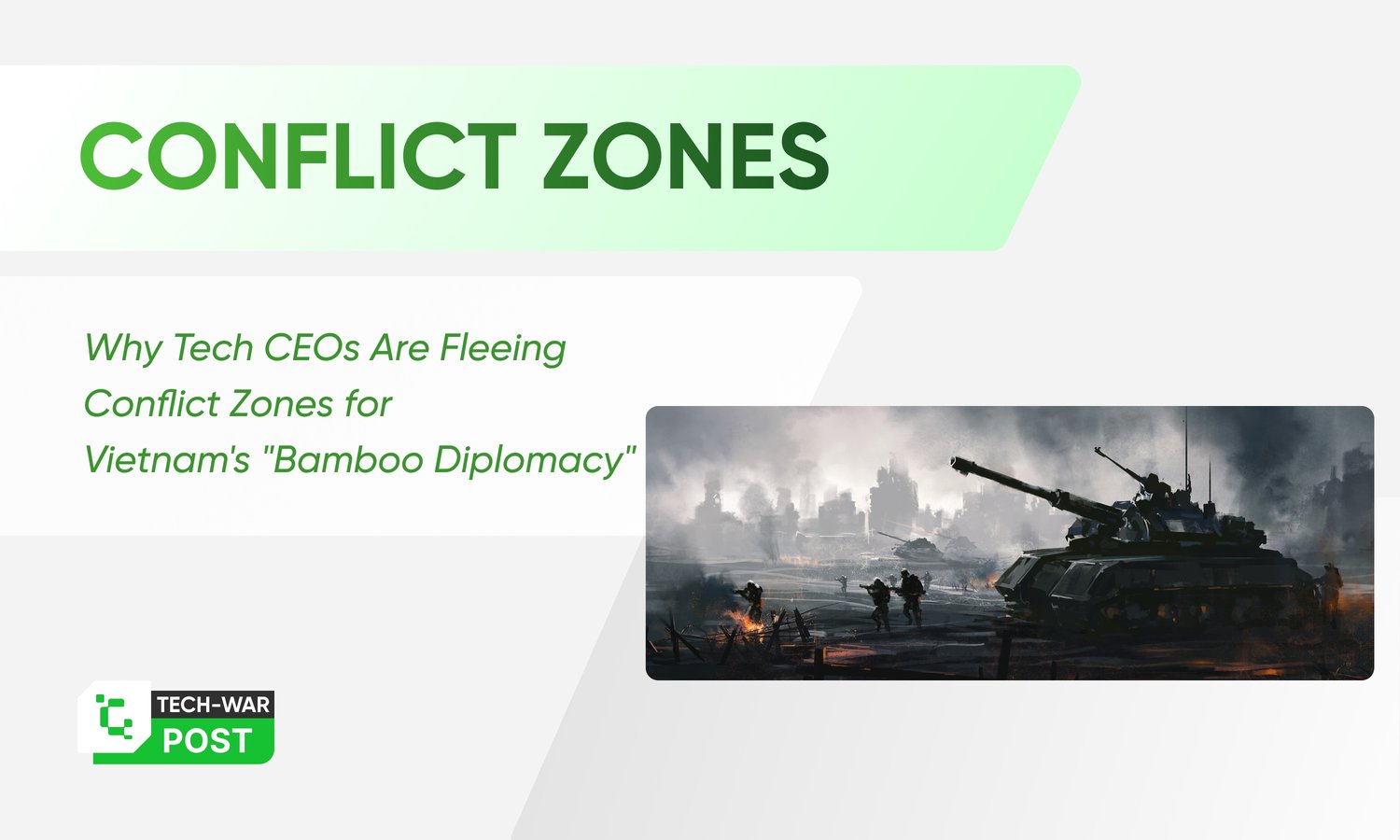

The New Geography of Risk
If you are a founder or CEO, the news cycle right now is terrifying.
You are watching supply chains fracture. You are seeing talent pools disrupted by conscription and conflict. You are reading about cyber warfare that doesn't respect borders. For business owners in the US, Europe, and the Middle East, the question is no longer
"How do we grow?"
but
"How do we protect what we've built?"
In the last 12 months, I have spoken to dozens of tech leaders. They are exhausted. They are tired of waking up to headlines that threaten their operations. And they are doing something about it: they are moving their talent pools.
But they aren't moving to the usual suspects. They are moving to Vietnam.
Why? It is not just about cost anymore. It is about survival and stability. And Vietnam offers something that Silicon Valley, Sydney, and Singapore cannot guarantee right now: geopolitical neutrality.
What is "Bamboo Diplomacy"?
Vietnam has a foreign policy that is as resilient as it is flexible. They call it "Bamboo Diplomacy."
Like a bamboo tree, the Vietnamese government bends to the winds of global politics, maintaining strong relationships with the US, China, Russia, and Europe simultaneously but it never breaks. It never picks a side that would jeopardize its economic future.
While other nations are being forced to choose between superpowers, Vietnam remains a trusted partner to all. In fact, Vietnam has recently elevated its ties with the EU to a Comprehensive Strategic Partnership, its highest diplomatic status, signaling a deepening commitment to Western partners even as it maintains balanced relations with China
For a tech CEO, this is not just political trivia. This is a risk mitigation strategy.
When you build a team in Vietnam, you are not betting on a country that could be cut off from Western markets tomorrow. You are not betting on a country that will be dragged into someone else's war. You are betting on a nation that has spent 50 years perfecting the art of staying out of trouble while getting rich.
1. Physical Safety
While the world burns, Vietnam builds. Ho Chi Minh City and Da Nang are booming with infrastructure projects, new tech parks, and a young population focused on one thing: economic prosperity. There is no draft. There is no civil unrest driving engineers out. There is only opportunity. The country recently recorded 8% GDP growth despite global headwinds and new tariffs from its largest export market .
2. Data Sovereignty
With new investments from global players like the UAE's G42 building billion-dollar hyperscale data centres in Ho Chi Minh City, Vietnam is rapidly becoming a hub for secure, sovereign data . The government has issued breakthrough policies like Resolution 57 on science and technology innovation at the national level, creating a regulatory framework that protects Western IP . Leading outsourcing providers now hold ISO 27001 and ISO 9001 certifications to ensure compliance with global standards like GDPR .
3. Supply Chain Continuity
The "China Plus One" strategy is old news. The new strategy is "Conflict Plus One." If your current development hub is in a region vulnerable to escalation, you need a backup. Vietnam offers a deep talent pool of over 600,000 IT professionals ready to step in and keep your product roadmap on track, no matter what happens elsewhere . The country ranks 7th in Kearney's Global Services Location Index, reflecting strong confidence in its delivery quality and pricing stability.
The "Land and Expand" Opportunity
Here is the reality: relocating a team is hard. Setting up a legal entity, navigating local labor laws, and building a culture from scratch is a distraction you do not need.
That is where a partner like Glinteco comes in.
We are not just a vendor. We are the landing pad. We have spent years building the infrastructure—the talent vetting, the HR compliance, the physical office space—so that when a CEO from Tel Aviv, London, or San Francisco decides it is time to move, they can have a team up and running in weeks, not years.
We understand that Vietnamese developers earn global certifications from AWS, Microsoft, and Google Cloud, positioning them as capable contributors to global tech ecosystems . We also know that Vietnam produces 50,000 to 57,000 IT graduates annually, ensuring a continuous pipeline of fresh talent
We handle the bamboo. You focus on the product.
The Bottom Line
The world is getting smaller and more dangerous at the same time. The winners in the next decade will not be the companies with the most funding; they will be the companies with the most resilient operations.
Vietnam is open for business. It is stable. It is neutral. And it is hungry.
As one analyst put it, Vietnam faces a "strategic crossroads" in 2026, but its multi-aligned diplomacy and reformist goals continue to bolster its global profile . The country is open for business. It is stable. It is neutral. And it is hungry.
If you are a founder looking to de-risk your talent pipeline, the question is no longer "Should I look at Vietnam?" It is "Why didn't I look sooner?"