Your Mind Is Not For Sale: UNESCO Adopts First Global Standard on Neurotechnology Ethics
By dunghv, at: Dec. 16, 2025, 3:19 p.m.
Estimated Reading Time: __READING_TIME__ minutes
The conversation around digital ethics has been dominated by AI and deepfakes. But a new, more intimate frontier has just been addressed by the world community: Neurotechnology - devices and systems that can read, interpret, or even influence the brain.
With the recent adoption of the first global ethical standards on neurotechnology by UNESCO, the world finally has a framework to govern what is arguably the most sensitive data of all: the contents of the human mind.
The Wild West of Mental Data
Neurotechnology is no longer science fiction. While medical applications like deep brain stimulation for Parkinson's are strictly regulated, the consumer market has been a "Wild West." Connected headbands, advanced headphones, and wearables are increasingly capable of harvesting "neural data" to monitor stress, sleep, and even subtle emotional states.
The rapid convergence of these devices with sophisticated Artificial Intelligence (AI) has created a system capable of decoding and interpreting this brain activity with unprecedented accuracy. This means that a person's inner thoughts, emotional profile, and cognitive biases, once considered the last inviolable domain of privacy, are now ripe for monetization and manipulation.
Enshrining the Inviolability of the Human Mind
The new UNESCO standards are a crucial step, establishing clear ethical boundaries and upholding what the Director-General called the “inviolability of the human mind.”
Key ethical features of this global framework include:
-
Mental Privacy & Freedom of Thought: Upholding the individual's right to control their own mental and emotional information, protecting against external interference.
-
A New Data Category: Defining and protecting “neural data” as a distinct form of personal data that requires special safeguards against illegitimate access, misuse, and commercial exploitation (like using brain patterns for subliminal marketing).
-
Protection for the Vulnerable: Advising against the non-therapeutic use of neurotech on children and young people, whose brains are still developing, and cautioning against workplace monitoring of productivity or emotional states.
The View from Vietnam: Balancing Innovation with Protection
While the UNESCO standard sets the global benchmark, its real impact depends on implementation by member states. Vietnam, with its rapid digital transformation, presents a unique case of a developing economy seeking to accelerate innovation while simultaneously building a responsible digital framework.
Vietnam has proactively engaged with global standards, as seen in its efforts to align its AI ethics policies with UNESCO's earlier AI Recommendation. The nation's recent Law on Digital Technology Industry and Personal Data Protection Law (Decree 13/2023/ND-CP) have already established:
-
Risk-Based AI Classification: AI systems are classified by risk level, with high-risk systems subject to strict requirements, a principle that can be extended to neurotechnology.
-
Strong Data Protection: Decree 13 imposes strict privacy requirements, providing a foundational layer of protection for all forms of personal data, which would include neurodata.
This does not draw much attention atm.
The challenge for Vietnam's nascent neurotechnology sector, which is primarily focused on local innovations and digital health applications, will be two-fold:
-
Talent and Investment: Attracting the high-level expertise and capital needed to compete globally while adhering to stringent new ethical guidelines.
-
Regulatory Specificity: Moving beyond general data protection laws to create specific safeguards for the unique risks posed by neural data collection, ensuring that the drive for technological leadership doesn't compromise the mental privacy of its citizens.
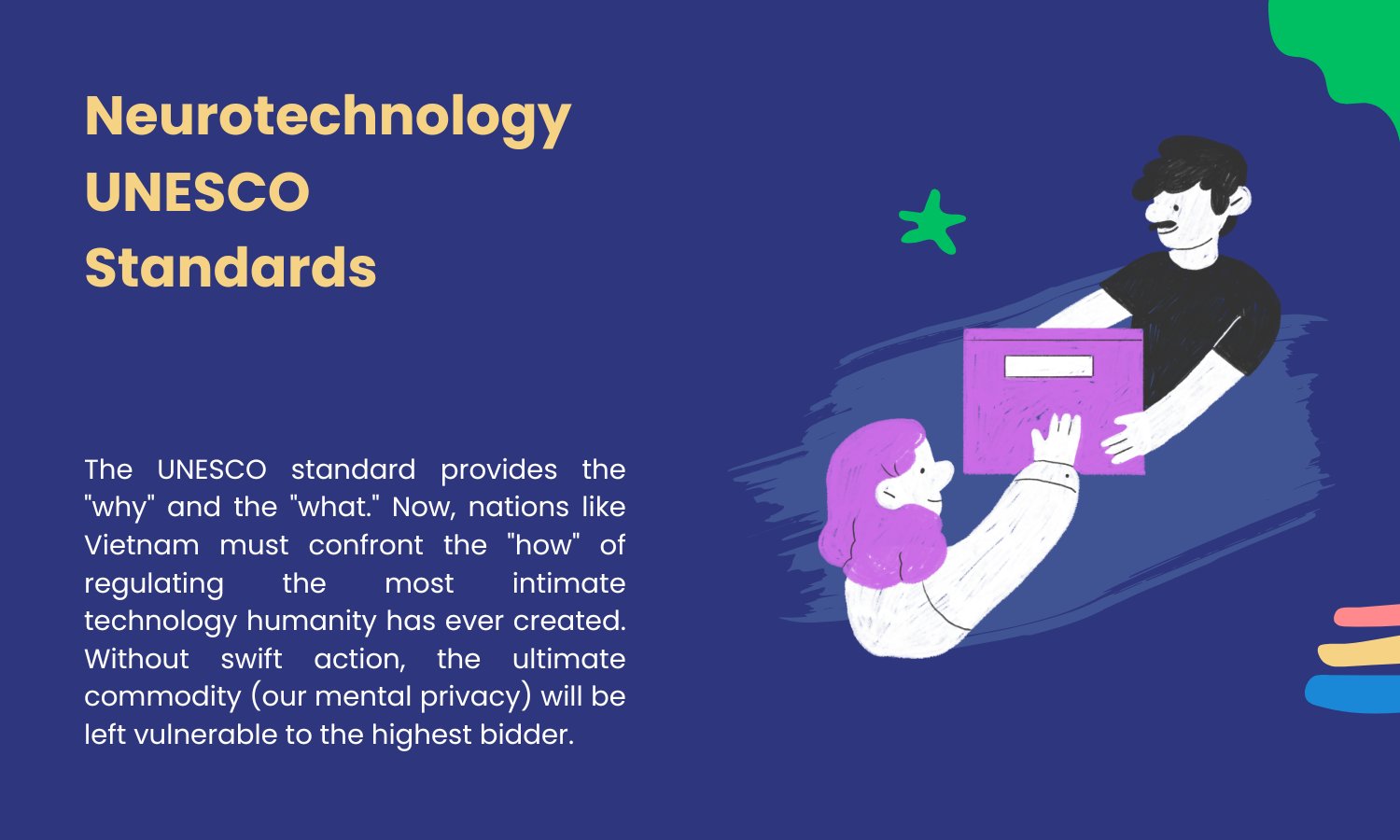
The UNESCO standard provides the "why" and the "what." Now, nations like Vietnam must confront the "how" of regulating the most intimate technology humanity has ever created. Without swift action, the ultimate commodity (our mental privacy) will be left vulnerable to the highest bidder.